192.168.1.1 Admin Login & Router Setup Guide 2026
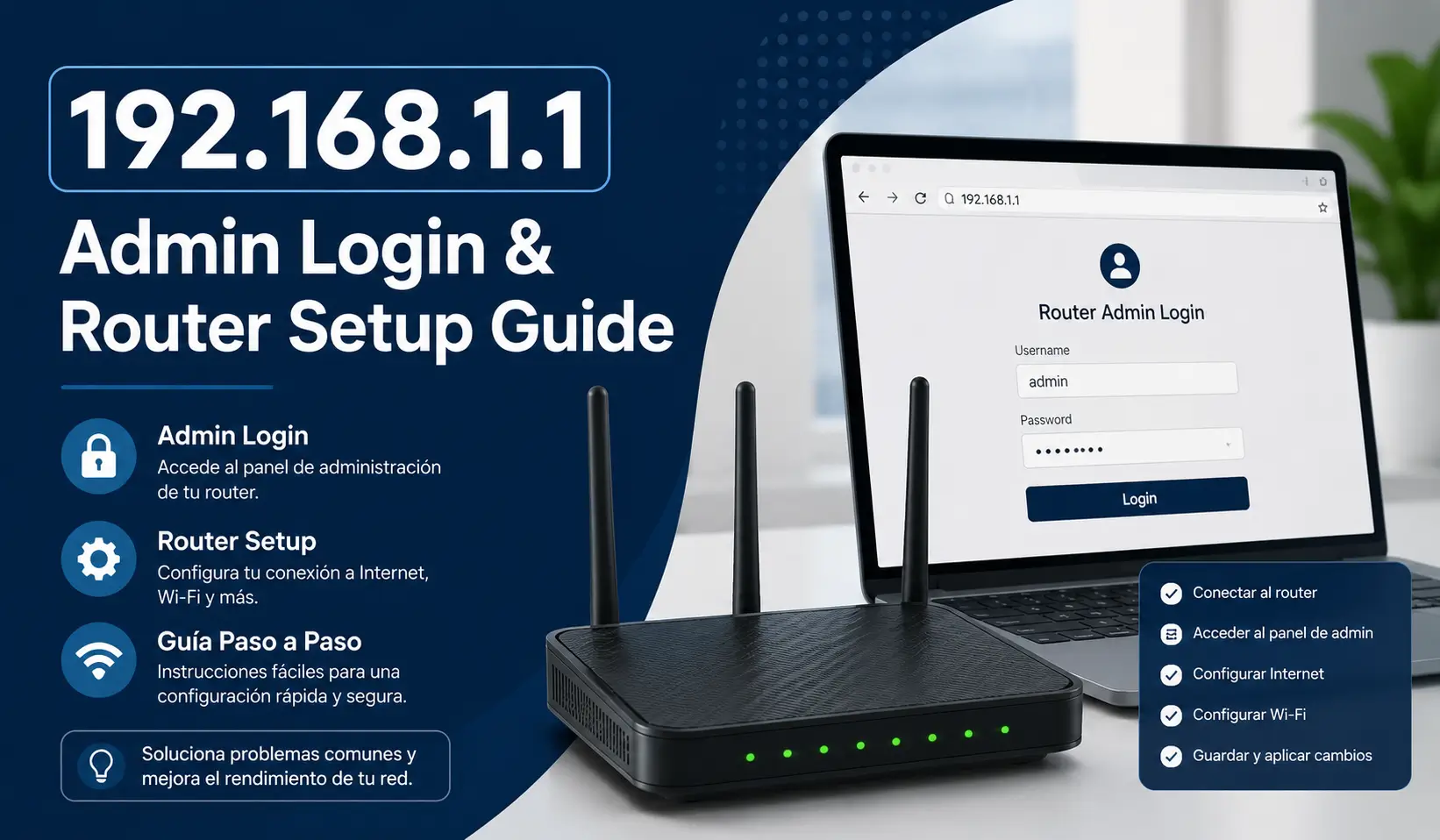
Getting into your router settings starts with one simple address: 192.168.1.1. This is the default admin login gateway used by millions of routers worldwide, and knowing how to use it puts you in full control of your network.
From changing your WiFi password to managing security settings, everything runs through this single access point. This guide walks you through the entire process, step by step, so you never feel lost again.
Default logins for 192.168.1.1
192.168.1.1 IP Address
If you have ever peeked at the back of your wifi router, you might have noticed a small sticker with the number 192.168.1.1 printed on it. That is not just a random string of digits. It is your gateway into the control room of your home network. Think of it as the front door to your router admin panel, where everything from DNS settings to WLAN configurations lives.
Every device sitting on your local ip address network needs a way to talk to the router, and 192.168.1.1 makes that conversation possible. Whether you are on the same network using a phone, tablet, or desktop, simply drop 192.168.1.1 into your web browser’s address bar and you are already halfway inside.
Default Logins for 192.168.1.1
Before anything else, you need the right credentials to get through the door. Based on real usage data, here is how default logins break down for the 192.168.1.1 IP address:
| % | IP Address | Username | Password |
|---|---|---|---|
| 60% | 192.168.1.1 | admin | admin |
| 10% | 192.168.1.1 | admin | – |
| 10% | 192.168.1.1 | admin | password |
| 4% | 192.168.1.1 | admin | 1234 |
| 2% | 192.168.1.1 | 1234 |
The clear winner here is admin as both username and password, covering a whopping 60% of cases. If those login credentials do not work, do not panic just yet.
There are still a few other combinations worth trying before you reach for the reset button.
How to Login to 192.168.1.1 Admin Panel
Getting into your router does not have to be complicated. Here is a straightforward way to do it without pulling your hair out:
- Open any browser and type http://192.168.1.1 directly into the URL bar, not the search bar.
- Once the router software loads, you will land on a login panel asking for your username and password.
- Enter your default user credentials manually. If the autocomplete feature tries to fill something in, ignore it and type it yourself. A single wrong character throws an error and nothing will load.
- If you have forgotten your login, recover your default password through the router’s recovery process or check the router usernames and passwords list printed on the device itself.
- Once past the login screen, you get full access to internet settings, configurations, and everything in between.
Note: Make sure you are not accidentally typing 192.168.l.l with a lowercase L instead of the number 1. This is one of the most common mistakes people make.
How to Find Your Router’s IP Address
Not every router runs on 192.168.1.1 and that surprises a lot of first-timers. If you are hitting a wall with long loading times or the page is not loading at all, your network might actually be sitting on a different address. Common alternatives include:
- 192.168.0.1
- 10.0.0.1
- 192.168.2.1
The easiest fix is to cross-reference a router IP address list online or run a quick tutorial search specific to your router model. Knowing the right IP address before accessing the router saves you from a frustrating loop of failed attempts. Once you have the correct one confirmed, issues like these disappear almost instantly.
How to Configure Your Router in Four Easy Steps
Most people expect router configuration to be a nightmare, but with a stable and reliable process it is actually quite straightforward. Here is how to do it:
Step 1: Prepare
- Gather your documentation including the user manual, default passwords, and default username
- Pick a central location in your home or office for the best wireless connection coverage
Step 2: Connect the Cable
- Run your ethernet cable into the WAN or wide-area network port at the back of the router
- Watch for the LED light to turn green, confirming the internet connection is live
- Double-check by connecting a laptop to one of the other ports
Step 3: Access the Router
- Open your internet browser and type 192.168.1.1 into the address bar
- Do not mix it up with dead-end addresses like 192.168.ll or 192.168.l.l
- Use your default password and username to log in
- Most routers come with an installation wizard that walks you through the heavy lifting
Step 4: Configure Settings
- Set your SSID or Service Set Identifier, which is the name of your wireless network
- Create a secure password to protect your connection
- Fine-tune settings like private IP address ranges, port forwarding, and DDNS as needed
Getting Connected
Before you even think about configuration, getting physically connected is step one. Here is the order that works every time:
- Check internet: Grab your ethernet or ISP cable and plug it directly into a laptop or computer to confirm the internet connection is actually working.
- Unbox the router: Glance through the manual for the default gateway and login details. Place the router on a higher shelf or central location in the room.
- Power it up: Plug the router into the power source and give it time to boot. A green light is usually the signal that it is ready.
- Connect to internet source: Plug your broadband cable, DSL modem, or ISP gateway cable into the internet port, which typically stands out by color or placement compared to the other ports.
Troubleshooting 192.168.1.1
Sometimes things do not go as planned and that is completely normal. Here are the most common friction points and how to fix them:
- Check the connection: Make sure the router is connected to your computer or devices through an ethernet cable or WiFi. Check all indicator lights including the Power light, Internet light, WI-FI light, and Ethernet lights.
- Reboot: Unplug both the router and modem, wait a moment, then replug them one by one. Give it a solid two minutes before checking again.
- Disable the firewall: If you are sitting behind a firewall, disable it temporarily to rule out any conflict with firewall settings that might be blocking router access.
- Check the address: Open your browser and manually type 192.168.1.1 into the address bar, making sure it is not 192.168.l.l.
- Factory reset: If nothing works, press the reset button on the router to bring it back to factory settings. Before doing that, double-check your default username and default password using the router usernames and passwords list or your recovery instructions.
What is 192.168.1.1?
Every device that connects to the internet needs a unique address, just like how a postal address, email, or telephone number identifies a person in the real world. On networks, this is called an Internet Protocol or IP address.
Your router hands out IP addresses to every device that joins, while also holding its own. These addresses fall within private network ranges that are never assigned to any public website. Those ranges are:
- 192.168.0.0 to 192.168.255.255
- 172.16.0.0 to 172.31.255.255
- 10.0.0.0 to 10.255.255.255
Every IP address is made up of 4 numbers sitting between 0 and 255. The breakdown works like this:
| Part | Description | Example |
|---|---|---|
| First three numbers | Network Id | 192.168.1 |
| Fourth number | Device Id | 20 |
| Full address | Combined | 192.168.1.20 |
Every device on the same network shares those first three digits. DHCP or Dynamic Host Configuration Protocol running on the router makes sure each one gets a unique IP automatically.
Beyond your local setup, your router also carries a public address that the external network sees, handling the translation between private and public through a process called Network Address Translation or NAT.
Popular with Linksys, D-link, Asus, Netgear, TP-Link
Out of every address available in the home network range, 192.168.1.1 became the go-to default gateway because it is easy to remember and consistent across devices. That means anyone can access the administrative console of their router without digging through manuals every single time.
The following mainstream manufacturers use 192.168.1.1 as their default router IP:
- Linksys
- D-link
- Asus
- Netgear
- Cisco
- Tp-Link
- Tenda
- SMC Networks
- Huawei
- Dell
That level of standardization across the industry made 192.168.1.1 almost universal. Your router manual will confirm the specific router IP for your model, but chances are it is this one.
How do I change my WiFi password?
Changing your WiFi Name and WiFi Password is one of the first things worth doing after setup. Here is the full process through the admin dashboard:
- Open your browser and go to https://192.168.1.1
- Log in using the default username admin and default password 1234
- To change your WiFi Name:
- Go to Basic, then tap Wireless LAN or WLAN Settings
- Find the SSID Name field
- Type your preferred WiFi name
- Click Apply Changes and Save
- To change your WiFi Password:
- Go to Wireless LAN or WLAN Settings
- Select Security
- Under Encryption or Security Mode, choose WPA2-MIXED
- Go to Pre-shared Key
- Enter your new preferred WiFi password
First time logging in? The system will prompt you to update the default username and password under the Account Management section. That same page also gives you direct access to the SSID Name and WiFi Password fields, so you can update everything in one visit.
Router Username and Password List
Not every router shares the same login credentials. Below is a reference table to help you find the right default credentials for your device:
| Brand | Model | Protocol | Username | Password |
|---|---|---|---|---|
| 2WIRE | HOMEPORTAL Rev. SBC YAHOO! DSL | none | 2Wire | none |
| 2WIRE | ALL WIFI ROUTERS | HTTP | none | Wireless |
If your brand is not listed here, check the label on the back of your router or the manual that came in the box.